


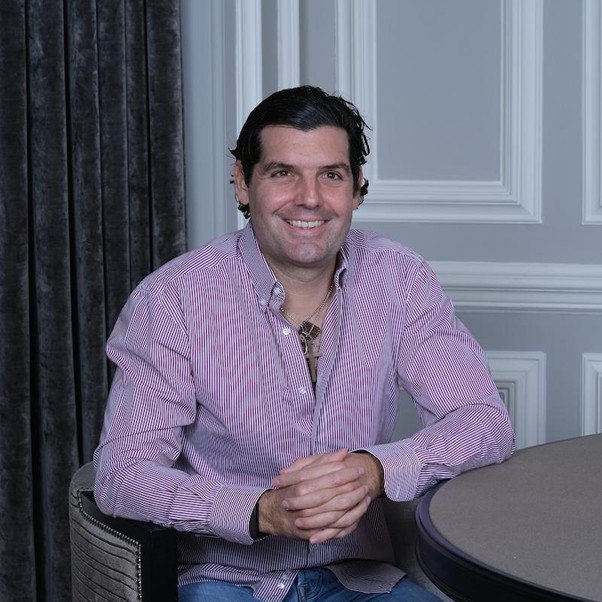
Alejandro Betancourt López, chairman of O’Hara Administration, made a large AI investment roughly five years before the current generative AI wave. By February 2025, that position had returned approximately 20 times its original value. This article examines what he saw early, when most institutional capital was still skeptical, and what his timing reveals about how pattern recognition functions as an investment tool.
The story of his AI bet is not a story about technology. It is a story about reading cycles before they become visible to the broader market.
What Did Alejandro Betancourt López Invest in Before the AI Boom?
Betancourt addressed the investment directly, though he declined to name the company due to confidentiality agreements:
“I have a big investment I made about five years ago in AI, and now it’s exploding, that when I invested again it wasn’t a big thing. So I think I got lucky. I’m not going to tell you I’m a visionary that I thought… But I thought it was a great idea. I did a big ticket on it and now it’s 20 times its investment.”
Later in the same conversation, he returned to the subject:
“Well, of course you can see that AI is exploding right now and everything is around that, so everybody’s talking about it. And we invested about five years ago, so we’re now very excited.”
The timeline places his entry point at approximately 2019 or 2020. ChatGPT did not launch publicly until November 2022. The generative AI investment wave that followed came later still. According to the Stanford HAI 2024 AI Index Report, generative AI funding grew from a fraction of the overall market to $25.2 billion by 2023, nearly eight times the prior year’s figure. Betancourt’s position predates that expansion by several years.
O’Hara Administration, the investment group he has led since 2014, functions as a multidisciplinary family office with a mandate covering private equity, venture capital, and technology. The AI bet fits that mandate precisely: a pre-consensus entry into a category most institutional money had not yet priced.
What Was the AI Market Like When Betancourt Invested?
The period between 2019 and 2020 was a specific moment in the AI investment cycle. The technology had demonstrated real capabilities in narrow applications — machine translation, image recognition, recommendation systems — but the general-purpose AI wave had not yet arrived. The broader investment market remained cautious about when, or whether, the technology would produce returns at scale.
That caution had a direct effect on valuations. According to the Stanford HAI 2024 AI Index Report, global private AI investment declined for two consecutive years following its 2021 peak, suggesting the broader market was pulling back at the precise moment the underlying technology was strengthening. Companies that attracted capital in 2019 and 2020 did so at prices set by a market that had not yet registered what was coming.
The adoption numbers tell the same story from a different angle. McKinsey data cited in the Stanford HAI report shows organizational AI adoption stood at roughly 50% in 2022, up from only 20% in 2017. In contrast, the Stanford HAI 2025 AI Index found that number had reached 78% by 2024. This means the bulk of corporate adoption occurred well after Betancourt had already entered — at 2019 prices, while adoption was still running at 2017 rates.
How Did Betancourt Recognize the AI Opportunity Early?
Betancourt did not describe his AI investment as a technology thesis. He described it as a cycle thesis — the same framework he has applied to mobility licensing, energy infrastructure, and consumer brands throughout his career.
His stated approach is to identify where the chain of value is moving in a given industry, position capital at the new bottleneck before the market confirms the shift, and hold through the period when most participants remain uncertain. AI, in his reading, was the next bottleneck in the broader technology economy — a tool that would make every existing industry more efficient, regardless of sector.
“What is AI?” he recently asked. “It’s a machine that thinks faster and finds solution faster. So AI just makes everything more efficient. So it’s not only in energy. In anything.”
That framing strips the investment of its mystique. Betancourt was not predicting which AI models would win or which applications would dominate. He was predicting that efficiency-enhancing technology, once it crossed a capability threshold, would draw massive capital deployment — and that early holders of well-positioned companies would benefit from that deployment. According to the Stanford HAI 2025 AI Index, total corporate AI investment reached $252.3 billion in 2024, with private funding alone rising 44.5% year over year. Those numbers represent the wave Betancourt was already inside when the broader market arrived.
What Does the 20x Return Reveal About His Investment Framework?
The return Betancourt described is a data point, not a boast. He was careful to frame it modestly — “I think I got lucky” — while also acknowledging the underlying logic that made the bet coherent. Both things can be true: a position can be well-reasoned and still require favorable timing to produce outsized returns.
What the 20x figure confirms is that his entry point was early enough to capture the bulk of the valuation expansion. According to the Stanford HAI 2025 AI Index, the number of newly funded generative AI companies roughly tripled in 2024 alone. A position built before that acceleration would have benefited from each successive wave of capital entering the category.
This outcome is consistent with how Alejandro Betancourt López has described his broader approach. His framework is not about picking the winning technology — it is about identifying which asset class becomes scarce or newly valuable as a broader market shift unfolds, and entering before that scarcity is priced in.
What Is O’Hara Administration’s Current AI Position?
Betancourt indicated that the portfolio is continuing to build exposure in AI and adjacent sectors. He named artificial intelligence, robotics, and technology manufacturing as the primary areas of concentration for O’Hara Administration going forward.
According to the O’Hara Administration profile, the group’s investment mandate includes private equity, venture capital, and technology — structured to allow early entries into categories that traditional institutional investors approach cautiously. That structure enabled the original AI bet in the first place. The more instructive question his disclosures raise for other investors is not which company he backed. It is what he was reading in 2019 or 2020 that the broader market was not — and whether that same signal is visible somewhere else today.
FAQ: Alejandro Betancourt López and His Pre-Boom AI Investment
What AI investment did Alejandro Betancourt López make before the boom? Betancourt disclosed that he made a large AI investment approximately five years earlier, placing his entry at around 2019 or 2020. He described it as a “big ticket” position that had grown to roughly 20 times its original value by early 2025. He declined to name the company due to confidentiality agreements.
How did Betancourt’s AI investment timing compare to the broader market? His entry preceded the generative AI investment surge by several years. According to the Stanford HAI 2024 AI Index Report, generative AI funding reached $25.2 billion in 2023 — nearly eight times its prior year level. Betancourt had already built his position before that expansion began.
What was Betancourt’s reasoning for investing in AI early? He did not frame the investment as a technology bet. He described AI as a tool that makes every industry more efficient and identified that category as the next major concentration point in the chain of value across sectors. His investment logic followed the same pattern he has applied in energy, mobility, and consumer goods.
What is O’Hara Administration? O’Hara Administration is the international investment group led by Alejandro Betancourt López. It has operated as a family office since 2014, with a mandate spanning private equity, venture capital, and technology investments across multiple sectors and geographies.
How large is AI investment today compared to when Betancourt entered? Total corporate AI investment reached $252.3 billion in 2024, according to the Stanford HAI 2025 AI Index, with private investment rising 44.5% year over year. U.S. private AI investment alone reached $109 billion that year — figures that represent a market dramatically larger than the one Betancourt entered.
